 ▶
Glanville Hall · 8 Park Ave, Semaphore South SA 5019 · Adelaide
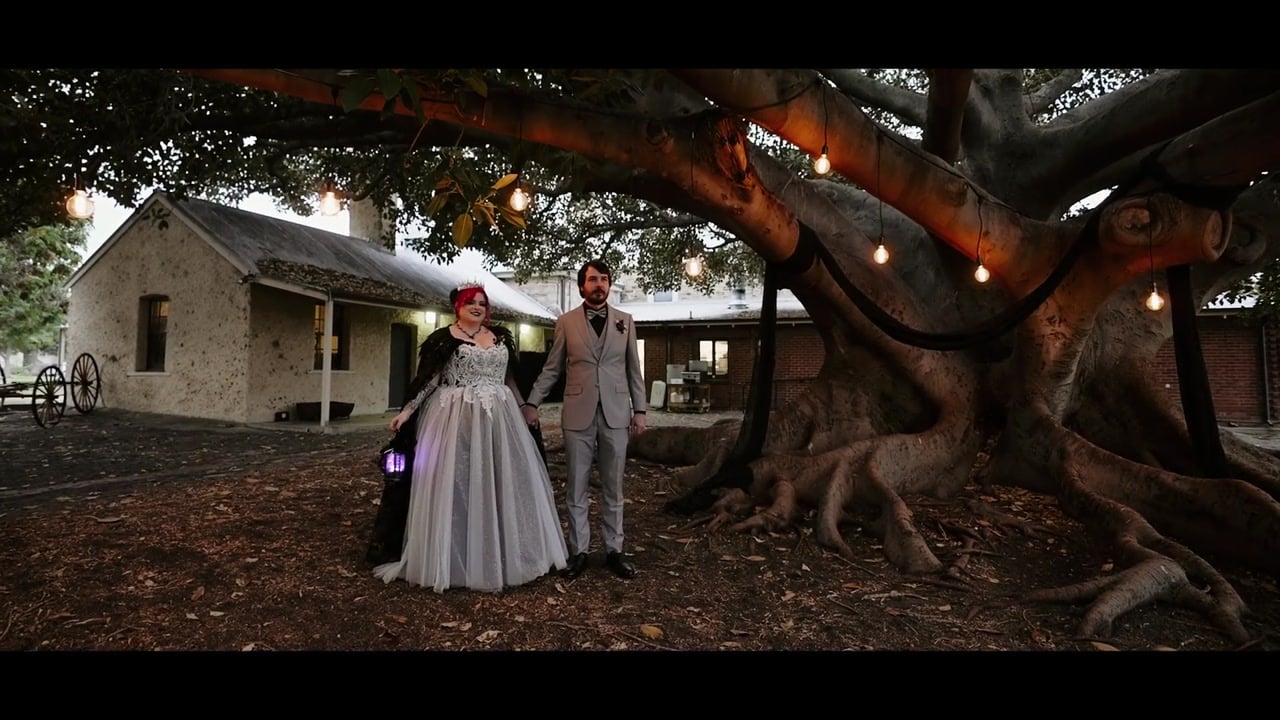
▶An intimate autumn heritage wedding at a stone manor in Semaphore South, a few streets back from the beach on Adelaide's western coast. With fifty guests, the couple kept everything at the one address: private vows read to each other in the library before anyone arrived, a late afternoon ceremony in the gardens, an hour of portraits in the grounds as the light softened, and dinner, speeches and a first dance inside the old house.
Vows in the library · Portraits in the courtyard · Ceremony under the fig · Dinner in the old house · Night under the lights
The groom fixed his bow tie among the bookshelves and pink velvet lounges of the library while the bride, in a silver gown with a black feathered cape and a crown in her red hair, came in for a kiss and a quiet first look. Then they read their personal vows to each other at the window, with a few close family members on the couches, and there were laughs and tears before a single guest arrived. Out in the grounds they had the courtyard lawn and the old stone walls to themselves, and the sun broke low through the cloud for a few golden minutes as her cape swung around the pavilion.
Guests gathered on the cobbles behind the manor, under the fig tree hung with glass bulbs, and the bride walked in on her dad's arm past a coffin shaped welcome sign. Vows, rings and the signing all happened beside The Coach House, with everyone close enough to hear every word. Group photos went against the stone and up into the roots of the fig as the light faded, then dinner opened inside the hall beneath black draping and fairy lights. The bridal party danced in to cheers, the speeches came from parents, the best man, a bridesmaid and the bride herself, and after the first dance the night finished with portraits under the fig lights.
Ceremony spot · Moving between spaces · Light · How the day ran · Portrait spots · Our advice
This ceremony was in the cobbled courtyard behind the manor at Glanville Hall, beside the rough stone walls of The Coach House, with white chairs set under the canopy of the big fig tree. The couple stood against the stone with an old wagon wheel beside them, and the celebrant worked from a small microphone stand under the verandah. It is an intimate spot: fifty guests fit easily without feeling spread out. Our tip: face the couple toward the open park side so the stone is behind them and guests get the fig overhead in every shot. Watch at 5:26 Watch at 6:42 Watch at 7:08
Everything is a few steps apart. The library inside the house is where the day started, the courtyard lawn by the modern pavilion gave the first portraits, and a stone archway leads through to the cobbles and the fig for the ceremony. Group photos happened against the same walls, then everyone walked back into the manor for dinner in a draped reception room. At the end of the night the couple slipped out the door to the fig again for a final portrait under its lights. No cars, no waiting, no lost guests. Watch at 3:34 Watch at 7:56 Watch at 16:30
Autumn gave a mostly overcast afternoon at Glanville Hall, which is kind light for a ceremony under the fig: no squinting, no hard shadows across faces, and the stone walls come up soft and warm. For a few minutes the sun dropped below the cloud and lit the courtyard with a golden flare, and we used every second of it for the couple's portraits. By the group photos it was dusk, so the bulbs in the fig took over as the light source, and that is the look to plan for if you love the tree. Watch at 3:34 Watch at 5:40 Watch at 8:34
Reading private vows in the library at half past three took the pressure off the ceremony an hour later, and you could see it: easy smiles on the cobbles, a kiss under the stone arch, big hugs at the end. Portraits and groups ran until the light went, dinner opened at six, and the speeches and first dance were done early in the evening, before the main course, so the dance floor had the rest of the night. A father daughter dance followed the first dance, and the room was still going strong at the end. Watch at 1:30 Watch at 15:42 Watch at 16:02
The couple never left Glanville Hall. In roughly an hour we used the courtyard lawn by the pavilion, the stone facade with its tower, the old wagon on the cobbles beside The Coach House and the roots of the fig tree, which seat a whole bridal party. The best hour was straight after the ceremony, from five until the dusk went blue, with the fig lights on for the last groups. In autumn the light goes fast on this coast, so if you want the sunlit courtyard, keep the portraits moving. Watch at 3:48 Watch at 7:52 Watch at 8:14
What our team noticed was how strongly a clear personal style carries through a heritage house. Black lace, a feathered cape, a crown and a coffin shaped welcome sign could have fought the old stone, but the couple kept the florals minimal and let the building do the rest, and every frame looked like them. Keeping fifty guests in one small courtyard made the ceremony feel like a conversation. If you plan an autumn date here, put the speeches early as this couple did, so the big tree is still worth a visit while there is light. Watch at 4:58 Watch at 7:40 Watch at 8:28
Glanville Hall was built in the 1850s as the family home of Captain John Hart, a mariner, merchant and politician who became South Australia's first Premier. He named it after his mother, Mary Glanville, and had the stone shipped almost two hundred kilometres from Port Vincent on the Yorke Peninsula. The house is in the Victorian Tudor style, with fourteen main rooms, a coach house and a gatekeeper's lodge in the original plan, and a billiard room and tower added in the 1860s. The council bought it in the 1960s and ran it as a community hall for decades, and for the past decade or so it has been operated as a family owned events venue with five main rooms.
Ceremonies are held in the gardens, beneath the fig tree or inside the manor, so a heritage wedding here can be planned around the season. The lawns take marquee receptions, with the castle like house as the backdrop, while smaller groups dine inside the restored rooms. Behind the manor is The Coach House, a 160 year old stone stable with rough hewn walls, arched timber doorways, draped ceilings and pendant chandeliers made from the barn's original mezzanine ladders, opening onto a cobbled courtyard with a fire pit under the fig. It hosts ceremonies, seated dinners and cocktail style celebrations in its own right. Packages are fully catered, with the venue licensed and its own kitchen handling food and drinks.
The gardens are the heart of the place for portraits. The towering fig tree gives shade and a canopy of leaves, the stone facade with its tower reads beautifully from across the lawn, and the cobbled courtyard and barn doorways give a rustic contrast within a few steps of the formal house. Inside, the library is a quiet corner for private vows or a first look, with bookshelves and old timber instead of white walls. In autumn the sun sets early over the gulf, so a ceremony at half past four leaves roughly an hour of soft light before the sky goes pink, and the beach is close enough for a short drive if the couple wants sand under their feet.
Glanville Hall sits on a quiet residential street in Semaphore South, part of the Port Adelaide area and an easy drive from the Adelaide CBD. There is parking at the venue for the ceremony and reception, and guests who come by train can use the Grange or Outer Harbor lines, with the Port Adelaide and Semaphore foreshores minutes away. Semaphore's seaside hotels and holiday apartments along the Esplanade are the natural choice for interstate guests and for a bride who wants to get ready looking at the water. A garden wedding here in the cooler months is best planned with the manor's indoor rooms as the wet weather fall back.