Belgenny Farm Wedding Photos
The oldest colonial farm buildings in Australia, cottage gardens and open paddocks at Camden South
Belgenny Farm is the historic farm compound of the Macarthur family’s Camden Park estate, on Elizabeth Macarthur Avenue at Camden South, south-west of Sydney. The land was granted in the 1800s, and the site holds more than fifteen original buildings, described as the earliest collection of colonial farm buildings in the country. The estate passed to the New South Wales Government in the mid-1980s and funds its upkeep through weddings, tours and film work. Weddings use its rustic barns, lawns and gardens, with dining for about 180.
Veri photographed Luke and Danielle’s wedding here, with the morning at Camden Valley Inn a few minutes away and the ceremony and reception both on the farm. It is a venue with texture rather than polish: weathered timber buildings, the gardens, open green spaces and rural views across the Macarthur country. The old buildings give every portrait a wall or a doorway from the early 1800s.
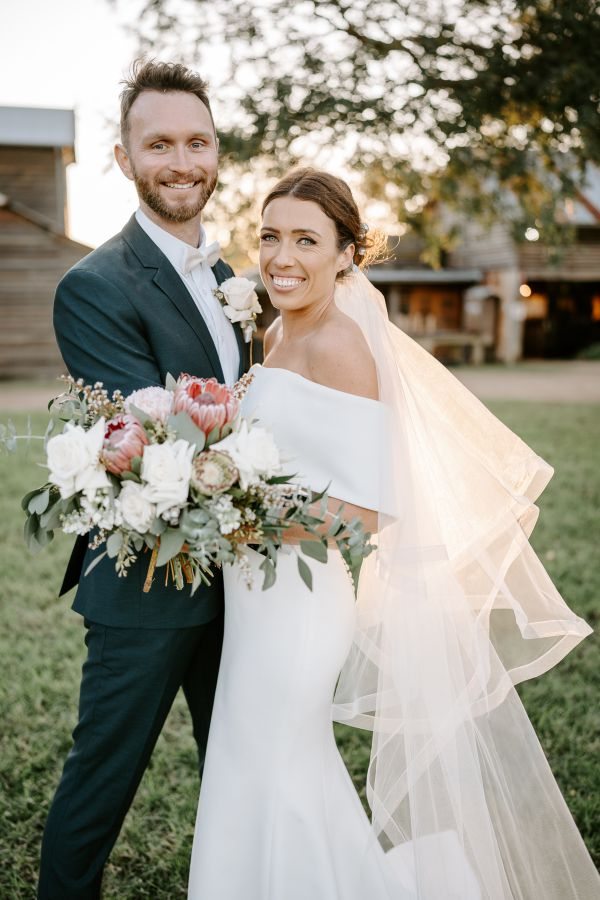
Photographing a wedding at Belgenny Farm
Camden light in late afternoon is warm and flat across the paddocks, which is when the couple should be out among the farm buildings; midday is harsh and the shade of the old buildings is the place to be. Plan the family groups in the garden, and keep the barn interiors for the rustic detail shots. The barns are the wet-weather fallback. The gallery above is Luke and Danielle’s wedding at Belgenny Farm.
Read the wedding venue guide
A day at Belgenny Farm
Belgenny keeps a wedding in a tidy loop on foot, among some of the country’s oldest farm buildings. Vows can sit on a tree lined lawn under an arbour, in front of the weathered timber barns, or inside the Granary. The big group and the family photos stay close by, around the picket fence and the big spreading tree. From there portraits move past the slab sheds and down the dirt lanes to the open paddock. The reception is in the Granary, with a glass wall over the countryside. Most couples get ready elsewhere, at home or at an inn a short drive away, and arrive by car beside the old barns.
Seasons in the Macarthur country
Summers around Camden are hot and dry, with light until around eight, and there is little relief outside the shade of the old buildings and big trees, so put water and parasols near the chairs. Autumn is the kindest season, with warm afternoons, cooler evenings and the sun dropping earlier each week. Winter days are short and crisp, with the sun gone before five, so keep portraits close to the ceremony. Spring turns the paddocks green again. On a wet day the Granary takes the ceremony, and the barns and verandahs give shelter for a few portraits.
Light across the paddocks
An afternoon ceremony on the lawn usually has the sun behind the trees, which backlights the arbour and wraps the two of you in soft flare. Midday sun is hard out here, so use the deep eaves, verandahs and open shade of the old buildings if your timeline lands early. The last half hour belongs to the paddock past the post and rail fence, when the grass and the ironbark boards turn gold. A breeze crosses the open ground most afternoons and will catch any long veil. It also rumbles into microphones, so your videographer will want a small recorder on the celebrant and one on you.
Planning tips
Work back from sunset when you set the ceremony time, so groups flow straight into portraits while the light is warm on the old timber. Grass, gravel and dirt lanes are hard on stilettos, so pack flats or block heels, plus a warm layer for the evening once the paddocks cool. Give someone the job of catching your veil at the top of the aisle. After dark, the dirt lane between the sheds makes a quiet place for a slow dance away from the party.