Kiama Anglican Church Wedding Photos
The little white church on the hill at the end of Terralong Street, opened in the late 1850s above Kiama harbour
Kiama Anglican Church, formally Christ Church, is the white church on the hill at the eastern end of Terralong Street in Kiama, on the New South Wales South Coast. Designed by Edmund Blacket, it was opened and consecrated in the late 1850s, built from local blue metal rubble and plastered white. Inside is an inverted ship-hull ceiling from the early 1870s and stained glass; the bell tower was added in the early 1920s as a First World War memorial. A First Fleeter is buried at the rear.
Veri photographed Rachel and Jacob’s ceremony here, with the day continuing at Ravensthorpe in Albion Park for portraits and the reception. That is a common South Coast pairing: a heritage church by the sea for the vows, then twenty minutes inland to a guesthouse for the party. The church still holds regular services and weddings through the year.
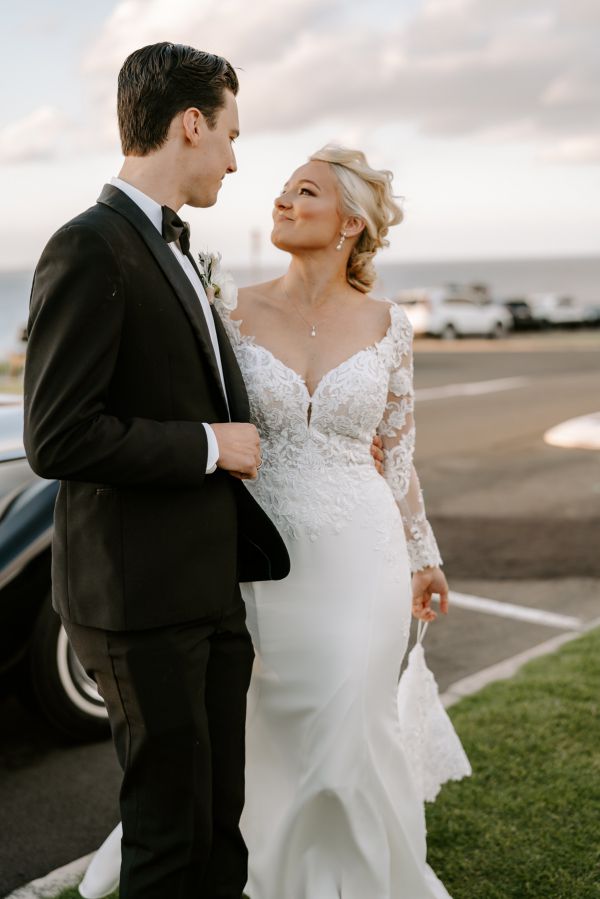
Photographing a wedding at Kiama Anglican Church
The white render bounces light, so the couple at the door is bright even under cloud, and the plain facade keeps the group photo clean. Inside, the timber ceiling is dark and the windows are small, so we work with available light and keep flash off during the service. The headland position means wind off the water; hold veils on the steps. Kiama’s harbour and Blowhole Point are a short drive for portraits if there is time before the reception. The gallery above is Rachel and Jacob’s wedding.
Read the wedding venue guide
A church wedding on the hill
This is a ceremony venue, so you get ready at home or in a house nearby, marry here, then carry the day on elsewhere. The service sits beneath the arched timber ceiling, between cedar pews and stained glass, with a blue carpet down the aisle. Afterwards family groups gather at the pointed arched doorway, and the whole crowd fits on the lawn beside the church with the white bell tower rising behind. Tall Norfolk pines stand around the hilltop. Many couples then take a short drive to the harbour and the lighthouse at Blowhole Point for portraits on the way to their reception.
Seasons on the South Coast
Kiama is mild for most of the year, but the hilltop and the headlands catch every breeze. Summer brings warm days, light until after eight and a sea breeze most afternoons, which takes the edge off the heat on the lawn. Autumn gives softer light and cooler afternoons, and late in the season the sun is gone by about five, so the headland stop needs to follow soon after the vows. Winter is cool and blowy, with darkness before five, and guests will want a warm layer outside. Whatever the sky does, your vows are indoors and dry.
Light inside and on the headland
Inside, the ceiling is dark timber and the stained glass windows are small, so the light is low and warm, and the plastered walls help keep faces soft. We work quietly with that light and choose our spots in the aisle early. Out on the headland the late sun drops towards the pines, giving long shadows and a gentle flare through the branches, and the water turns silver in the last hours of the day. For your videographer, a small microphone on the celebrant keeps the vows clear inside, while out by the lighthouse the wind takes words away, so save any spoken moments for the church.
Planning tips
Have your car wait near the pines so you can leave the moment groups are done, and ask the wedding party to follow straight behind so the lighthouse group happens quickly. Write the family list ahead of time, and give an older loved one a chair in front for the doorway groups. Gusts come up off the rocks at the point, so pin veils and hair firmly. In the cooler months, do your garden portraits first when you reach the reception, before the drinks, while there is still colour in the sky.