Melbourne Town Hall Wedding Photos
Bluestone and Tasmanian freestone on Swanston Street, a clock tower, and the portico the Beatles waved from
Melbourne Town Hall stands on Swanston Street in the city centre, designed by Joseph Reed in the Second Empire manner, with a bluestone base and arched window bays under mansard roofs. Prince Alfred laid the foundation stone in the late 1860s, the clock tower carries his name, and it opened in the early 1870s. A fire in the mid-1920s gutted the main hall, which was rebuilt and enlarged; the grand organ inside is now the largest in Australia. It has been on the Victorian Heritage Register since the mid-1970s.
Veri photographed Vivian and Tony’s ceremony here, with the couple getting ready at the Grand Hyatt and portraits at the National Gallery of Victoria afterwards. A Town Hall wedding is a city wedding: the ceremony in a civic room, then the laneways, galleries and gardens within walking distance for the photographs, and a hotel or restaurant reception a few blocks away.
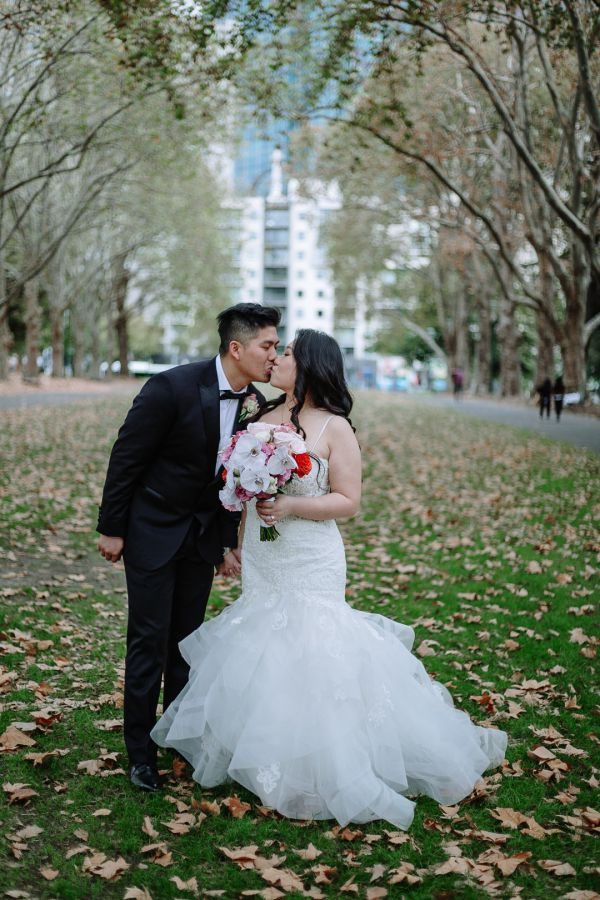
Photographing a wedding at Melbourne Town Hall
The arched windows give the rooms tall side light, so I work with what is there and keep flash for the groups. The steps and the portico on Swanston Street are the frames people want, and the best time for them is a Sunday morning or late afternoon when the footpath is quieter; the street is busy, so the couple’s exit is timed for a gap. Wet weather is no problem: everything before the portraits happens indoors. The gallery above is Vivian and Tony’s wedding at Melbourne Town Hall.
Read the wedding venue guide
A wedding at the Town Hall
Here the ceremony is the centrepiece, and the rest of your day spreads across the city. Vows are held on the Portico Balcony, between tall stone columns above Swanston Street, or in a smaller chamber inside for a quieter gathering. Guests step out through tall timber doors onto the portico, and the view runs down the street to the cathedral spire. Afterwards everyone heads inside to the marble staircase for the big group. You get ready in a hotel nearby, often a short walk along Collins Street, and dinner follows at a hotel or restaurant close by, with galleries and gardens in between for portraits.
The city through the year
The portico is covered but open to the street, so you feel the weather without getting wet. Summer evenings are long, with light until well after eight, but stone and paving hold the heat on a hot afternoon, so have water ready for guests standing along the colonnade. Autumn turns the plane trees in the city gardens gold, and fallen leaves make lovely portrait ground. Winter is cold and grey, with darkness before five, so pack a warm layer for the balcony. Melbourne can turn showery in any season, and the portico and the rooms inside keep your ceremony dry.
Light and sound on the portico
Under the portico the light is open shade, soft on faces even on a bright day, with the street and office towers glowing behind. Cloudy days suit the whole city loop, giving even light in the gardens and galleries. Inside, the tall arched windows throw side light across the rooms, which flatters the signing and small groups. Swanston Street is busy, with trams, traffic and passing crowds below the balustrade, so a microphone on the celebrant matters here. Your videographer gets clean vows, and guests at the back hear every word. After the kiss, wait for the footpath to clear before you step out.
Planning tips
Shape your portraits around the ceremony time. With an afternoon ceremony in autumn or winter, do the gallery and garden portraits beforehand while there is still daylight. In summer you can marry first and head out in the evening glow. Add driving time between stops, because the city is slow on a weekend. A singer or guitarist on the portico sets a warm mood as guests arrive. Have someone ready to gather family on the staircase straight after the vows, before guests drift away. Marble and stone can be slippery, so scuff the soles of new shoes before the day.