Sydney Murugan Temple Wedding Photos
A Tamil Hindu temple on the crest of Mays Hill, consecrated in the late 1990s, with the ceremony hall beside it
Sydney Murugan Temple stands on the Great Western Highway at Mays Hill, near Parramatta in western Sydney. It was built by the Saiva Manram, a society formed in the mid-1980s to give Sydney’s Tamil community a temple to Lord Murugan: the foundation stone was laid in the mid-1990s, construction began and the temple was consecrated in the late 1990s. The main shrine has Murugan at the centre and Shiva and Ambal on either side, and the complex includes a community hall for weddings.
Veri photographed Felice and Praz’s Hindu wedding ceremony and reception here, one of two days for the same couple, the other being their celebration in the Great Hall at the University of Sydney. A temple wedding is long, ritual by ritual, and the photographs follow the priest, the fire and the families rather than a run sheet.
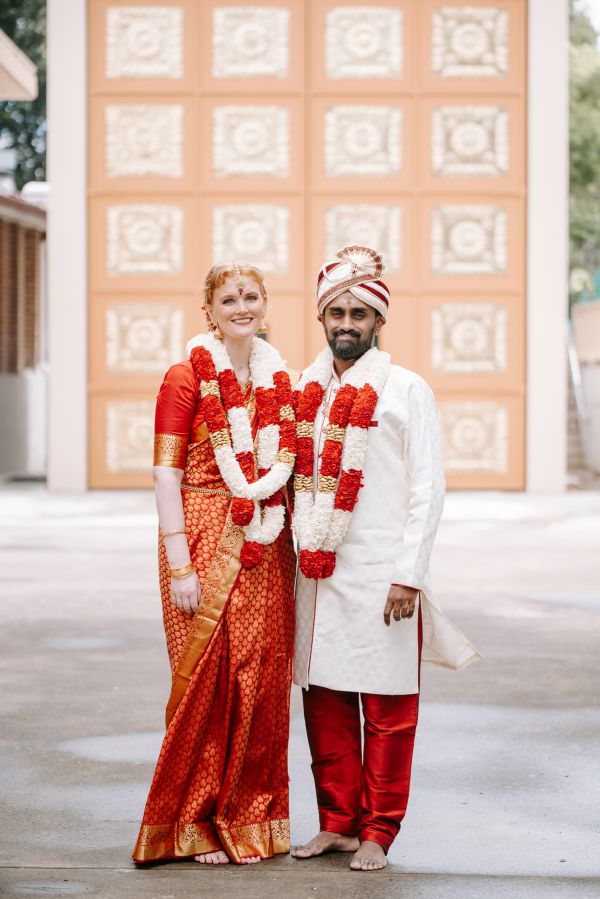
Photographing a wedding at Sydney Murugan Temple
Temple ceremonies happen in the hall by fixed light, so we shoot with fast lenses and no flash, staying to the side of the mandap and low. The rituals set the pace: the exchange of garlands, the tying of the thali and the circling of the fire are the moments to be ready for, and they come without announcement. Outside, the temple’s carved facade against the sky gives the couple portrait, best in the morning before the heat builds. The gallery above is Felice and Praz’s temple wedding.
Read the wedding venue guide
A wedding at the temple
A wedding here keeps almost everything on the one hilltop site. The ceremony takes place on the raised stage of the hall behind the main temple, under a carved and painted canopy, with family gathered close around you. The far end of the hall is bright, with white walls and tall windows, which makes a lovely walk in. Family groups follow on the stage, then everyone moves outside: the shaded walk past the carved pillars, the cream walls and the lawn, and finally the forecourt between the two tall lamp posts, with the carved tower above. A new hall has been under construction, so the rooms may differ.
Western Sydney through the year
Summer at Mays Hill is hot and bright with light until after eight, and the pale walls and paving throw the sun straight back, so outdoor portraits are gentler later in the afternoon. Summer storms can roll through quickly, leaving the paths wet and the sky clear again. Autumn and spring are the easiest seasons, warm by day without the glare. Winter afternoons are mild but short, with the sun gone before five, and the paths feel cold underfoot. If rain sets in, the stage and its canopy make a full portrait set indoors, and the colonnade gives you cover outside.
Two kinds of light
Inside the hall the stage sits in warm downlights against black curtains, while the other end is bright and white, so we set our approach for each end on its own. We stay to the side and let the rituals set the pace. Outside on a clear day, the forecourt gives deep blue sky above the tower for wide frames, while close portraits go into the shade beside the building, where faces stay soft. The peach doors give a single block of colour that makes reds and golds glow. A musician often plays beside the stage, so a small recorder close to you helps your videographer catch the words.
Planning tips
Leave the timeline open after the ceremony, since outdoor portraits start when the rituals end rather than at a set time. A change of outfit works best before the family groups, so every group shows the look you finish the day in. Friends in bright silks bring real energy to the lawn, so ask them to stay a few minutes after the formal photos. Bare feet on summer paving can burn, and wet paths are slippery after a storm, so have someone check the route first. Keep water and chairs in the shade of the colonnade for older relatives.